
Backlash is the price feminists, LGBTQ+ people, and women human rights defenders pay for disrupting entrenched hierarchies. In the Countering Backlash programme we have seen how this plays out in many different forms across the different domains of policing, controlling, and regulating women’s bodies, excluding and silencing women in political institutions, and restricting their access to resources.
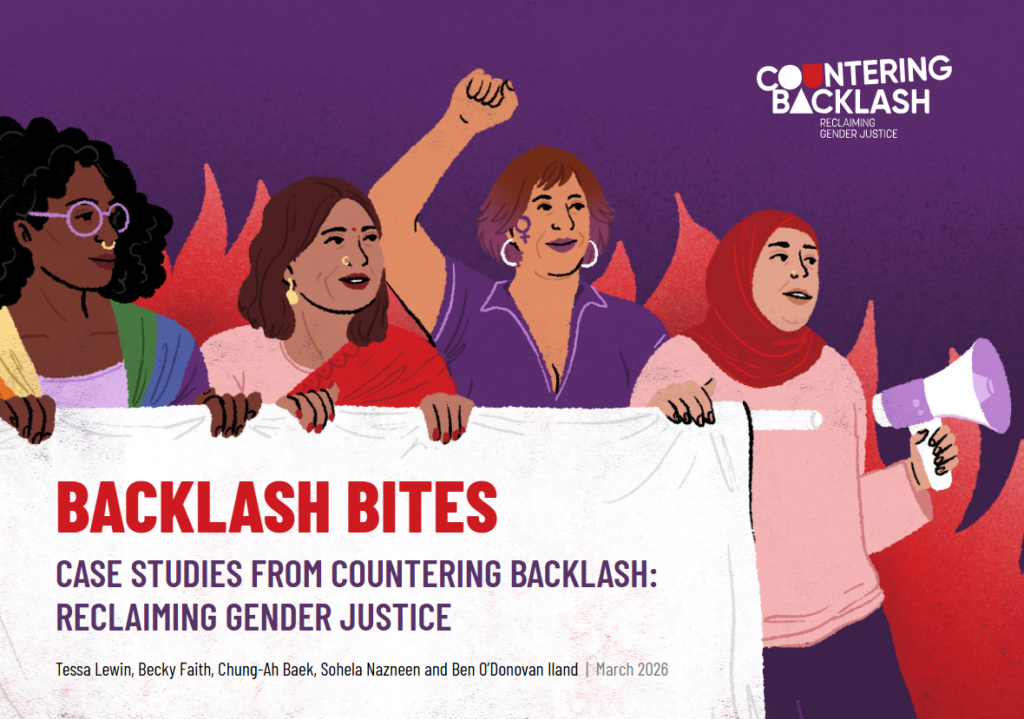
These case studies provide a snapshot of trends from our partners in Bangladesh (BRAC Institute of Governance and Development), Brazil (Núcleo de Estudos Interdisciplinares sobre a Mulher/Centre for Interdisciplinary Studies on Women, Federal University of Bahia (NEIM)), India (GenderSphere), Lebanon (Arab Institute for Women at the Lebanese American University) and Uganda (Centre for Basic Research, Women of Uganda Network), showing continuities and global trends, and celebrating the countertactics that are countering backlash.
These cards are intended to illuminate and inspire – to show both the complexity and continuity of our struggles. We do this through showing the issues at stake, and how and why this is backlash; a timeline of events; the individual and collective actors working for and against backlash; and, finally, successful countertactics.
These case studies draw on the work of the Policy and Practice and Voice strands of the Countering Backlash programme. We are very grateful to our colleagues in Bangladesh, Brazil, India, Lebanon, and Uganda for their original research work and for sense-checking these case studies. Thanks to Alice Webb, Priya Raghavan, and Melanie Judge for their reviews. This research was made possible by the Countering Backlash: Reclaiming Gender Justice research programme, funded by the Swedish International Development Cooperation Agency (Sida).